
Golf Bag Tips: 10 Common Mistakes Made in Packing and Carrying a Golf Bag
Posted by Danny on Aug 27th 2026
There's a moment every golfer knows. You set your bag down on the tee box, it teeters for a second, and then it tips over sideways into the wet grass. Or you're standing over a wedge shot with the group behind you already on the tee, digging through the third pocket in a row looking for a tee you know you packed.
Here's the thing: that's almost never the bag's fault. The most useful golf bag tips have nothing to do with the bag you bought and everything to do with how it gets loaded, carried, and stored between rounds. A well-built bag packed badly will frustrate you every single hole. An average bag packed well disappears into the round, which is exactly what a bag is supposed to do.
The good news is that all of this is easy to put into practice, most of it in under a minute, and not one of these tips requires buying anything. Here are ten habits that make a golf bag easier to live with, and why each one matters.
Table of Contents
- The 10 Golf Bag Tips at a Glance
- Packing and Weight Tips
- Organization and Club Protection Tips
- Carrying and Transport Tips
- How Often to Reset Your Bag
The 10 Golf Bag Tips at a Glance
Before the details, here's the whole list in one place. If you're short on time, the table alone will get you most of the way there.
Golf Bag Packing Tips and Why They Matter
Ten habits that keep a bag lighter and better organized, what each one saves you on the course, and how to put it into practice.
| The Tip | Why It Matters | How To Do It |
|---|---|---|
| The Tip Pack only what you actually use | Why It Matters Saves you extra pounds on every step, plus strain on straps and seams | How To Do It Unload fully, then reload only what you actually used in your last three rounds |
| The Tip Keep heavy gear low in the bag | Why It Matters Prevents a top-heavy bag that tips over and pulls on your shoulder | How To Do It Store dense items low and close to the back panel, light items up high |
| The Tip Dry wet gear before it goes back in | Why It Matters Avoids mildew smell, stained lining, and corroded zippers | How To Do It Air-dry towels and gloves, and leave damp pockets unzipped overnight |
| The Tip Use the divider slots as designed | Why It Matters Prevents tangled grips, clicking shafts, and scuffed club finishes | How To Do It Give every club a consistent channel and put it back in the same one |
| The Tip Cover your woods and hybrids | Why It Matters Protects crowns from scratches and chipped paint caused by club-on-club contact | How To Do It Put a headcover on every wood and hybrid, every round |
| The Tip Adjust your strap system | Why It Matters Balances the load and stops the bag from swinging while you walk | How To Do It Set both straps so the bag sits high and snug against your back |
| The Tip Keep the valuables pocket clear | Why It Matters Keeps keys findable and protects your phone screen from loose tees and tools | How To Do It Keys, phone, wallet, and nothing else |
| The Tip Keep the rain hood with the bag | Why It Matters Keeps water off your grips when the weather turns mid-round | How To Do It Store it in its dedicated pocket and leave it there |
| The Tip Secure the bag to your cart properly | Why It Matters Stops bag twist, blocked pockets, and wobble on hills | How To Do It Use the pass-through channel and check pocket access before you roll |
| The Tip Reset the whole bag once a month | Why It Matters Clears out sand, loose tees, and dead weight before they pile up all season | How To Do It Empty the bag completely, shake out the base, and reload by zone |
Each of these takes a few minutes. If you only do one, start with the full reset, because it makes the other nine obvious.
Packing and Weight Tips
More than half of all bag frustration traces back to two questions: what went in, and where did it go. Get those right and the rest of the list gets easier.
Tip 1: Pack Only What You Actually Use
Open most golf bags and you'll find a museum of good intentions. Three gloves, two of which are stiff and unusable. Eighteen balls when you'll lose two. A wind shirt from a round three seasons ago. Sunscreen that expired during a different presidency.
It adds up faster than golfers expect. A walking round covers roughly four to five miles, and every extra pound gets carried across all of it. By the 14th hole, that weight shows up as fatigue, and fatigue shows up in your tempo.
Riders benefit here too. A bloated bag is harder to lift onto the cart, harder to lift off, and harder to find anything in. The approach is a simple honesty test: pull everything out, then only put back what you touched in your last three rounds. Anything else goes in a bin in the garage where you can grab it if you genuinely need it.
Tip 2: Load Heavy Gear Low and Close to Your Back
This is the tip almost nobody thinks about, and it's the one that changes how the bag feels the most.
As a general rule, keep dense items close to the back panel and avoid concentrating heavy gear high in the bag. When heavy items ride up top instead, two things happen. On the course, the bag becomes top-heavy and tips forward off its legs, usually onto the one patch of wet grass available. On the walk, the load sits higher than your center of gravity and pulls your shoulder forward, which is why some golfers finish a round convinced their bag is heavier than it actually is.
Where Gear Should Sit in Your Bag
A simple loading map that works with nearly any pocket layout, from a lightweight stand bag to a full cart bag.
| Zone | What Belongs There | Why |
|---|---|---|
| Zone Bottom pockets | What Belongs There Extra sleeves of balls, tools, cooler contents, spare shoes | Why Keeps the center of gravity low so the bag stays stable on its legs |
| Zone Middle pockets | What Belongs There Rain gear, an extra layer, your towel | Why Balanced weight and easy to reach without setting the bag down |
| Zone Top pockets | What Belongs There Tees, ball markers, divot tool, glove, snacks | Why Light items you grab constantly, kept within arm's reach |
| Zone Valuables pocket | What Belongs There Keys, phone, wallet | Why Lined and separated so nothing hard rides against your screen |
Cart users: the same logic applies, but check pocket access after you strap the bag down. Weight in the right zone does not help much if the cart strap sits across the pocket you need.
Tip 3: Dry Everything Before It Goes Back Into The Bag
You finish a damp round, stuff the wet golf towel and a soaked glove into a pocket, zip it shut, and leave the bag in a closed trunk. Four days later the whole bag smells like a basement.
Moisture trapped in a zipped pocket has nowhere to go. It works into the lining, feeds mildew, and sits against zipper hardware long enough to leave corrosion that turns a smooth pull into a fight. Rain gear can be a major offender because wet fabric folded tightly into a closed pocket can hold moisture against the surrounding material for hours.
This one costs you thirty seconds. Pull the towel and golf glove out when you get home and let them dry somewhere with air moving. Leave the wet pocket unzipped overnight. If the bag itself got soaked, stand it upright with all the pockets open rather than laying it on its side in a hot trunk.
Organization and Club Protection Tips
Once the weight is sorted, the next batch of habits is about what happens to your clubs while they're riding around in there.
Tip 4: Use the Divider System
Divider systems come in a lot of configurations, from simple 4-way and 6-way tops to 14-way layouts where every club gets its own channel. Some are full-length, running all the way to the base, and some are partial, dividing only the top few inches.
None of that matters if you shove three clubs into whichever opening is closest. Crammed clubs mean tangled grips, which is why pulling one club sometimes lifts two. It also means shafts resting against shafts for four hours of cart vibration, which is where the clicking noise and the finish wear come from.
Build a habit instead of a system: assign each club a consistent location. On a 14-way bag that may mean one opening per club; on a 4- or 6-way bag, keep the same groups of clubs together. Long clubs toward the back near the strap, wedges and short irons toward the front where you reach most. Within a week you'll be pulling clubs without looking, which is the actual goal.
Tip 5: Cover Your Woods and Hybrids
Club-on-club contact inside the top cuff is a common source of cosmetic damage on woods. Every cart path bump, every trunk load, every drop of the bag onto pavement moves those crowns against each other. Head covers will keep your clubs looking like new.
Drivers and fairway woods are the priority since their crowns are the most visible and the most easily chipped. Hybrids are worth covering too, because they sit at the same height and take the same hits. Beyond the look, well-kept clubs hold their value considerably better if you ever trade up or sell a set.
Tip 6: Keep the Valuables Pocket for Valuables
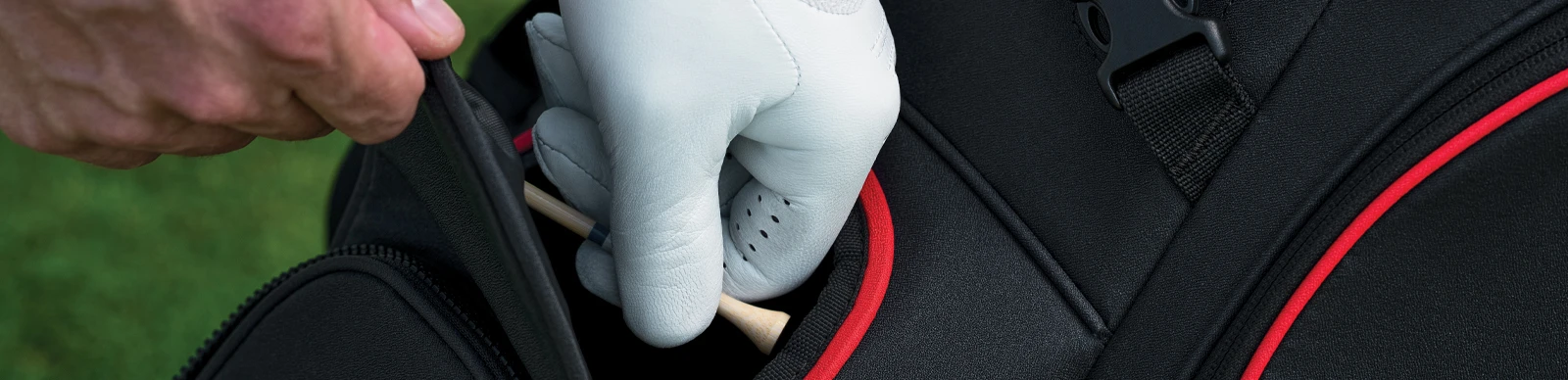
Your bag has a lined, fleece-padded, usually water-resistant pocket for one reason: to protect the things that shouldn't get scratched or wet. Left alone, it slowly fills with loose tees, a divot tool, a rogue ball marker, and half a granola bar.
Loose tees in a valuables pocket are essentially a bag of tiny chisels riding against your phone screen. Keep that pocket to keys, phone, and wallet. Everything small and sharp gets its own home in a top pocket where it belongs.
Carrying and Transport Tips
The last group is about the interface between you and the bag, which is where the most-ignored tip in golf lives.
Tip 7: Adjust Your Straps, Then Re-Adjust Them
Most golfers set their straps once, on the day the golf bag came out of the box, and never touch them again. But strap position can have nearly as much impact on carrying comfort as the weight of the bag itself.
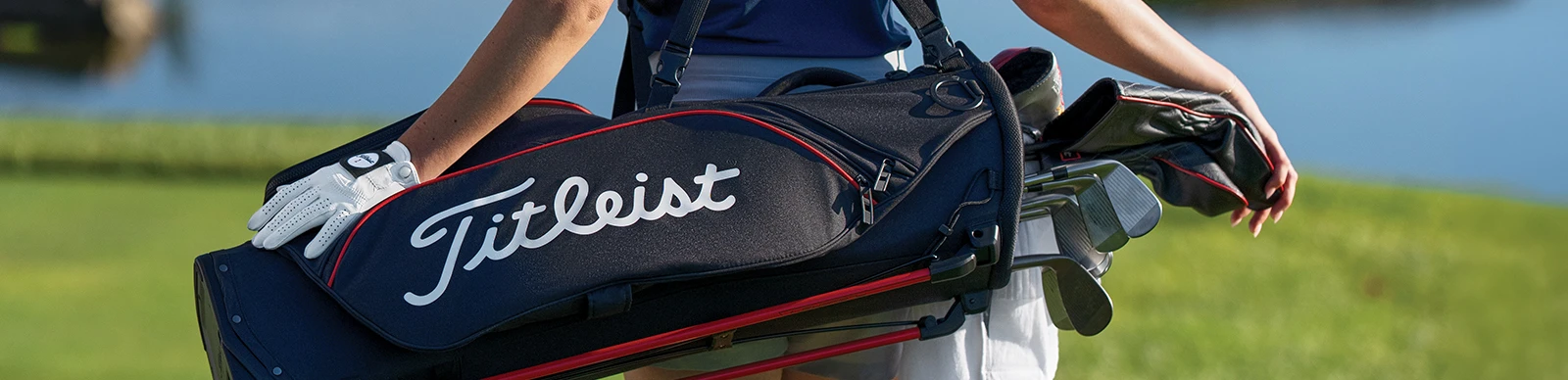
The bag should ride high on your back, with the top of it sitting near shoulder height and the body of the bag snug against you. When straps are too loose, the bag sags toward your hips, swings with every step, and forces you to lean forward to counterbalance it. A dual strap harness needs both sides set evenly, and the sternum strap actually matters, because it keeps the two straps from sliding outward off your shoulders.
Worth remembering: your layers change through the season. Straps set for a t-shirt in July will be too tight over a mid-layer and jacket in November. Re-check them whenever the weather turns.
Tip 8: Find Your Rain Hood and Keep It With You
Most bags ship with a rain hood, tucked into its own pocket, and a remarkable number of golfers have never located it. The cover keeps water off your grips, which is the difference between a wet round and an unplayable one, since a soaked grip is a genuine loss of control rather than just an inconvenience.
Find yours, leave it in its dedicated pocket, and take it with you whether the forecast looks threatening or not. Bonus use: pull it over the top of the golf bag during off-season storage and it doubles as a dust cover.
Tip 9: Strap the Bag to Your Cart the Right Way
Many cart bags have a flat base and a cart-strap pass-through channel on the back for a reason. When the strap goes across the bag rather than through the channel, two things go wrong. The bag can rotate under braking or on a slope, and the strap almost always ends up lying directly across a pocket you need.
Round-bottomed golf bags create a different situation on push carts. Without a flat, stable base to sit into the cart's bracket, the bag twists on the frame and shifts every time a wheel hits a root. If your bag wobbles on your cart, check the base shape before you blame the cart.
Before you push off, do a ten-second check: make sure the base is seated, the strap is through the channel, and every pocket you use mid-round is still reachable.
How Often to Reset Your Bag
Tip 10: Reset the Whole Bag Once a Month
This is the one that quietly takes care of the other nine. Bags accumulate unexpected weight. Sand collects in the base, tees migrate into corners, and gear you stopped using six months ago just stays put because you never see it.
A full reset is straightforward. Take everything out, including whatever is hiding in the bottom of the ball pocket. Turn the bag upside down and shake the base out. Wipe the interior of the pockets. Then reload using the weight zones from earlier, putting back only what you actually use.
A cadence that works for most golfers:
- Every few rounds: Quick pocket check. Pull the wet towel, restock balls and tees, take out anything that doesn't belong.
- Monthly: Full unload and shake out. This is where you catch the slow accumulation before it becomes weight.
- End of season: Deep clean, dry thoroughly, and store upright somewhere temperature-stable rather than in a trunk or an uninsulated shed.
Do the monthly version consistently and the other nine tips mostly take care of themselves, because you can't ignore a top-heavy, mildewed, overloaded bag when it's spread across your garage floor.
Frequently Asked Questions
Quick answers to the questions golfers ask most about packing, loading, and storing a golf bag.
How much should a golf bag weigh when fully packed?
It depends on the bag type, but a packed carry or stand bag in the neighborhood of 20 to 25 pounds total, including clubs, is comfortable for most walkers. Cart bags run heavier because the cart does the work. If your packed bag feels punishing by the back nine, the extra weight is usually in gear rather than in clubs.
Where should heavy items go in a golf bag?
Place heavy items low and close to the back panel, near the side that rests against your body. Extra balls, tools, and cooler contents belong in the bottom pockets. Keeping dense items low keeps the center of gravity low, which stops the bag from tipping off its legs and keeps the load from pulling your shoulder forward while you walk.
Why do my clubs get tangled in my golf bag?
Often it's because multiple clubs share a divider opening and their grips catch against one another inside bags. When grips sit against each other in the same channel, pulling one club lifts the ones beside it. Give each club its own slot where your divider count allows, and put clubs back in the same position each time. Full-length dividers help more than partial ones here.
Is it bad to leave a golf bag in your car?
Long-term, yes, you do not want to leave your bag in the car. Trunk temperatures swing dramatically, and heat combined with trapped moisture is hard on adhesives, linings, and grips. An occasional overnight is fine. Leaving a damp bag sealed in a hot trunk for a week is how mildew and stuck zippers start. Store it upright indoors when you can.
How do I stop my golf bag from tipping over?
Check your weight distribution first; a bag that tips is usually top-heavy from dense gear stored in upper pockets. Move that weight to the bottom pockets. Also make sure the stand legs are fully deploying and that the base and leg feet are clear of packed mud, which can keep the legs from spreading to their full angle.
How often should I clean out my golf bag?
A quick pocket check every few rounds and a full unload about once a month keeps things under control. Add a deeper clean at the end of the season before storage. The monthly unload is the important one, since it catches accumulated weight and forgotten wet gear before either becomes a real problem.
Small Fixes, Better Rounds
Look back at the ten tips and notice what's missing: not one of them is solved by buying a different bag. They're solved with ten minutes and a garage floor.
That's the part worth holding onto. Bag frustration feels like a gear problem, so golfers tend to shop their way toward a fix. Usually the bag is fine. It's carrying six pounds of gear nobody uses, loaded upside down, with straps set for a body position from two seasons ago.
Sort the weight, respect the dividers, dry things out, and reset once a month. Do that, and your bag stops being something you fight with and goes back to being something you barely notice, which is exactly what a good bag should be.
But if you've done all that and you really do need a new bag after all, check out what we have in stock.